How would fiction be different if reading a book gave us a character’s experience, not vicariously, but directly? To take the question at face value: we can. To challenge its premise: we already do. Here are three examples, from late-pulp adventure, Shakespeare’s Sonnets, and popular cognitive science.
William Goldman’s The Princess Bride (1973)
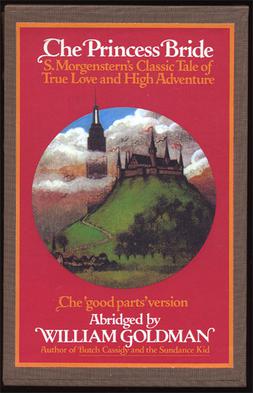
The screenwriter of iconic adventure movie The Princess Bride (1987) based it closely on his novel of the same name. He presents the book as his abridged edition of the “original” Princess Bride, an 18th century court satire by a fictional S. Morgenstern, famously long and boring. The book is introduced within the frame that his father (who becomes the grandfather in the movie), had read him the book as a child, rambling through it with familiarity, skipping the boring parts, interrupting the good parts, altogether making the reading as good as the story. But Goldman goes a step further, giving a listener his experience of having the book read that way. Goldman’s “good parts” version actually has a lot of boring parts. They’re inserted precisely where the grandfather skips around in the movie. They’re fun to read as an exercise in futility, Goldman has a fun tone, but they’re very openly about nothing, and when I was reading the book to my son he wouldn’t have any of it. I found myself skipping around the book just like in the movie. I got to be grandpa. That’s behavioral fiction.
Booth (1969) on Shakespeare’s “Sonnet 33”
I’ve shared before on the Shakespeare scholar Stephen Booth, and his argument that “each reading of a Shakespeare sonnet is a peculiarly real experience for its reader. It is the experience not of recognizing the mutable nature of the human condition but of participating in an actual experience of mutability.” In his 1969 An essay on Shakespeare’s sonnets he shows how “each reading of a Shakespeare sonnet is a peculiarly real experience for its reader. It is the experience not of recognizing the mutable nature of the human condition but of participating in an actual experience of mutability” His books show how Shakespeare plays and poems manipulate context, assumptions, and semantics to invoke in readers phenomena such as confusion, overstepping, and déjà vu.
Examples he points up are Sonnet 33 (Wherein “each violation of the reader’s confidence …evokes a miniature experience for the reader that mirrors the experience of betrayed expectations which is the subject of the poem …”), Sonnet 8 (second quatrain, “an emblem of the paradoxical conditions it recommends”), Antony and Cleopatra (III.x.2, whose “fusions and confusions of entities mirror and enhance the fusions and confusions of the identities of Antony and Cleopatra”). In the case of Sonnet 33, starting “Full many a glorious morning have I seen”, the attested plot of a person enjoying the sun until clouds arrive, twice, is paralleled by the sonnet’s alternations between treating the sun as the apparent subject of the poem, and as a metaphor for a loved one, twice.
Hofstadter’s Gödel, Escher, Bach (1979)
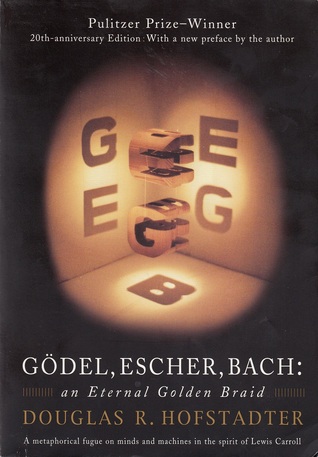
Douglas Hofstadter’s Pulitzer-winning GEB is a classic investigation of consciousness, completeness, and self-reference, each chapter introducing a thread in the “eternal golden braid” of his argument. Each chapter is broken up with a dialogue between Achilles and the Tortoise, making their cameo from Zeno’s paradoxes. What is special about these is that they transmit every concept while discussing them. A core theme of the book is how much we can infer about truth from what is not true. He motivates the tension with a discussion of figure and ground, pointing out cases from art (incl Escher), music (incl. Bach), and mathematics too, in which a whole can be inferred from its part. In the dialogue following the chapter, the Tortoise explains the concept to Achilles (or the other way around). Or he seems to. They’re talking on the phone, and we only get one half the exchange. But it seems to be enough to catch the point, while experiencing it, just how much we know when we know only a part.
Literary experience, the experience of literature, is often represented as vicarious experience. We’ve internalized that enough to be satisfied when a writer can make us feel like we’re really there with the characters, in the room, over the shoulders. But we can use words to incept experiences in each others’ minds. Behavioral fiction raises the bar on fiction by reminding us just how direct literary experience can be.